
What is an Endpoint? Reasons for Attention and Types of Security Measures

In recent years, businesses that effectively utilize the Internet have become widespread, and the transmission and sharing of information has become much more convenient than in the past. However, on the other hand, even stricter security measures are required.
In particular, with the rapid changes in working styles and the increasing number of cases where business systems are used in various locations, security at the “endpoint” is attracting attention.
This article will explain in detail the overview of endpoints, the overview and types of “endpoint security”.
Table of Contents
- What is an Endpoint?
- Reasons Why Endpoints Are Attracting Attention
- What is Endpoint Security?
- Importance of Endpoint Security
- Difference from Gateway Security
- Types of Endpoint Security
- EDR
- EPP
- NGEPP/NGAV
- DLP
- Summary
1. What is an Endpoint?

An endpoint is a word that means “end point” in English. In IT terminology, it has a more specific meaning, referring to “devices or terminals (devices) at the end point connected to a communication network.” For example, PCs, smartphones, and tablets operated by users, as well as printers and IoT devices, are endpoint devices.
There are various other communication network devices and terminals, but the following “devices and terminals that function as network functions” are not endpoints:
Not Endpoints:
- LAN router/Wi-Fi router
- Firewall
- Load balancer, etc.
2. Reasons Why Endpoints Are Attracting Attention

The specific reasons why the word endpoint has come to be noticed are as follows:
● Popularization of the Internet
A wide range of age groups are using the Internet, and the number of companies incorporating the Internet into some kind of business has increased dramatically. The number of cloud services provided by companies for companies has also increased, and now the endpoint, which is an Internet-enabled device, is essential for business and daily life.
● Spread of Telework
Telework has rapidly become popular as a way to respond to work style reforms and prevent the spread of new coronavirus infections. As the number of people working from home, cafes, rental offices, and coworking spaces has increased, the demand for endpoints that can be freely used in various locations has also increased.
● Diversification of Endpoints
Endpoints have become more diverse due to the spread of the Internet and telework. In addition to PCs, smartphones, and tablets, various types of IoT devices have been created. A wide variety of endpoints are very useful in various usage scenarios, but the literacy of users is also an important point.
3. What is Endpoint Security?
Endpoint security refers to taking some kind of security measure for endpoints.
Endpoints have begun to attract attention with the expansion of Internet-based business and changes in the working environment. Endpoints that can be used in a variety of situations are convenient, but stronger security measures are essential.
There are various methods of endpoint security suitable for each device/terminal, and it is possible to counter malicious malware, cyber attacks by third parties, and unauthorized access.
[What is Endpoint Security? From Important Reasons to Typical Types]
3-1. Importance of Endpoint Security
The importance of endpoint security is increasing with the spread of the Internet, telework, and the diversification of endpoints.
So why is endpoint security attracting so much attention? There are two reasons for this:
● Endpoints can directly access data and files
Data and files that you want to prevent unauthorized access to are accessed directly at the endpoint. Therefore, if a third party invades the endpoint itself, there is a possibility that more data and file information will be leaked than if the network were invaded. Endpoint security is extremely important in order to prevent all kinds of damage.
● Endpoints are the starting point for malware operations and unauthorized access
Endpoints are devices and terminals that directly access data and files, and are the closest to users. For malicious third parties who perform unauthorized access or cyber attacks, the endpoint is the entry point for attacks, but because it is familiar, it is easy to detect and prevent damage before it occurs. Therefore, it is important to always pay attention to endpoint security.
3-2. Difference from Gateway Security
In addition to endpoint security, security on the Internet includes “gateway security,” which protects against malware intrusion and unauthorized access from the network.
The differences between endpoint security and gateway security are shown in the table below.
| Endpoint Security | Gateway Security |
|---|---|
Purpose:
|
|
Protection target:
|
|
4. Types of Endpoint Security
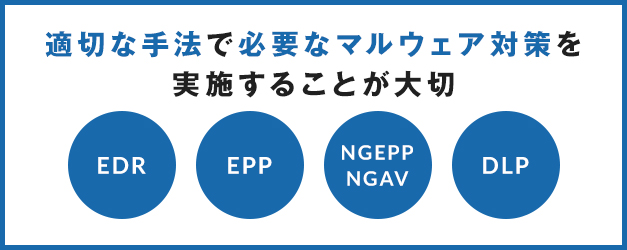
In order to protect your company’s devices and network from cyber threats, it is important to understand the types of endpoint security and implement the necessary malware countermeasures using appropriate methods.
The main types of endpoint security are as follows:
- EDR
- EPP
- NGEPP/NGAV
- DLP
In the past, gateway security was the mainstream, but with the diversification of malware, it has become necessary to implement endpoint security using all methods. Various security measures are required, which has the disadvantage of complicating device management and tool management, increasing the burden on administrators.
In recent years, “security software that combines multiple functions” has been appearing one after another. From here, we will introduce the overview of each type of endpoint security in detail.
4-1. EDR
EDR (Endpoint Detection and Response) is a technology that specializes in continuously monitoring endpoint devices and terminals, and providing support such as analyzing and identifying the source of intrusion when a virus infects or malware intrudes, and proposing the deletion of data files that are considered to be the cause.
Many EDR products can detect and identify the source of intrusion and the scope of impact even for unknown threats, which not only shortens the time to recovery but also minimizes damage.
4-2. EPP
EPP (Endpoint Protection Platform) refers to an “endpoint protection platform,” which is a technology that specializes in detecting malware and cyber attacks, preventing their spread, and minimizing damage. EDR is a product that supports responses after a virus infects or malware intrudes, while EPP is a product that prevents viruses and malware from intruding into terminals. A feature of endpoint security tools is that many products have both EDR and EPP functions.
Depending on the EPP product, it may be possible to analyze detected malware or repair data corruption caused by attacks from malware. In many cases, existing malware can be handled, but it is important to note that unknown malware may not be detected or handled.
4-3. NGEPP/NGAV
NGEPP (Next Generation Endpoint Protection Platform) and NGAV (Next Generation Anti-Virus) are both “next-generation antivirus” technologies that analyze the patterns of intruding threats, whether existing or unknown, and detect malware-specific behavior.
It can handle unknown threats that never cease and can detect advanced malware, so you can feel a great sense of security if you introduce it. However, be aware that many products can only monitor one endpoint per product.
[What is Next-Generation Antivirus (NGAV)? Differences from Conventional Types and EDR]
[NGAV: What is Next-Generation Antivirus? Explaining the Difference from Antivirus]
4-4. DLP
DLP (Data Loss Prevention) is a technology that specializes in preventing data leaks due to virus infections and malware intrusions.
Conventional information leak countermeasures generally involved “access restrictions using IDs and passwords.” However, this not only created an environment that made unauthorized access easy, but also reduced work efficiency, which was also seen as a problem.
DLP is characterized by monitoring the data itself. Conventional information leak countermeasures targeted all information, but DLP only targets specific confidential information, enabling the construction of a more robust security environment, as well as reducing management and operational costs and improving operational efficiency.
Summary
In IT terminology, an “endpoint” refers to a device or terminal connected to a communication network. Specifically, it refers to PCs, smartphones, and tablets operated by users, and endpoints have become more diverse due to technological advances and the spread of the Internet and telework.
Endpoint security is becoming increasingly important as endpoints become more diverse. There are various types and software for endpoint security, each with different roles. In order to counter cyber attacks and malware infections, it will be important to develop a security and monitoring system.
Contact us at globalsupport@jiran.com for further assistance.
