
What is a VPN? Understanding the Mechanism, Types, and Key Security Measures!
In recent years, cyber attacks involving malware intrusions have become increasingly sophisticated, raising concerns about security. Furthermore, the spread of remote work has created a need to handle internal company information securely, even from outside the office or on devices other than computers. VPNs are one connection method that can be used for security measures, but some company representatives may not fully understand them.
This article introduces the mechanisms and types of VPNs, as well as the advantages and disadvantages of implementing them, and key information security measures to consider during implementation. If you are concerned about your company’s network security, please refer to this article to deepen your understanding of VPNs and consider appropriate security measures for your company.
Table of Contents
- What is a VPN?
- Advantages and Disadvantages of VPNs
- Key Security Measures When Implementing a VPN
- Summary
1. What is a VPN?
VPN stands for “Virtual Private Network.”
Normally, networks are often shared, but a VPN creates a virtual private network line and can be used as a closed network, reducing security risks.
Here, we will introduce the mechanism and types of VPNs, and the differences from dedicated lines.
1-1. VPN Mechanism
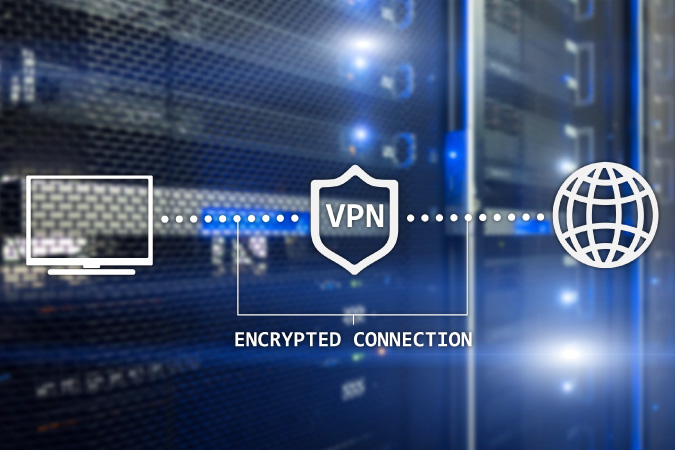
When using a VPN, communication is performed using public lines from a dedicated router. Dedicated routers are generally installed at company headquarters, etc., and by performing settings such as tunneling, encryption, and authentication, a dedicated line is constructed that prevents communication content from leaking to the outside.
Tunneling is a necessary setting for building a dedicated line. It is named after opening a virtual tunnel between the dedicated router serving as a base and the terminal using the network, and VPN connection is established by virtually isolating it from public lines.
Also, by setting up encrypted communication, it is possible to package data exchanged under the VPN connection and hide it from the outside. It’s similar to exchanging data in a capsule within the VPN.
Furthermore, an authentication system is required to start a VPN connection. Even if a virtual tunnel is opened, it is pointless if the tunnel is illegally invaded. Set an ID and password to prevent unauthorized use of the VPN.
In a VPN connection, only authorized people exchange encrypted data in a place isolated from public networks, so it can be said that a highly secure network environment can be built.
1-2. Types of VPNs
There are several types of VPN connection methods that can reduce security risks, so here is an overview of four representative types of VPNs.
| Internet VPN | A method of constructing a virtual dedicated line on an existing internet line. Since existing lines are used, line construction can be done inexpensively. On the other hand, specifications such as connection speed and communication line quality depend on the original line, and there are concerns about safety compared to other VPN connections. |
| Entry VPN | A method of constructing a virtual dedicated line using an optical broadband line. Because VPN is connected using a closed network that does not go through the Internet, users can be limited and security is high. While it is the cheapest in the closed network, communication line quality is unstable. |
| IP-VPN | A method of constructing a virtual dedicated line on a communication carrier’s own network. Because it is built on a closed network, functions such as limiting users and prioritizing lines can be added, so communication line quality is stable, but operating costs are high. |
| Wide Area Ethernet | Like IP-VPN, this is a method of constructing a virtual dedicated line on a specific network line. It has the highest degree of freedom among the four types of VPNs, and a high-quality network that matches the company can be constructed depending on the settings, but high skills and costs are required for operation. |
The four types of VPNs shown above each have advantages and disadvantages in terms of operating costs and communication line quality. It is best to comprehensively consider the content of the data you want to exchange and the degree of security required to determine which VPN connection to implement.
1-3. Differences Between VPNs and Dedicated Lines
Dedicated lines may be used as closed networks similar to VPNs. Both VPNs and dedicated lines can connect a location with a dedicated router to a terminal that uses the VPN or dedicated line, but the difference is whether communication between locations is possible. If a dedicated server at the head office and each location are connected with a dedicated line, the head office and the location are connected one-to-one, so even if a dedicated line is installed, communication between locations is not possible.
Dedicated lines have the advantage of being more secure than VPNs, but they also have the disadvantage of higher implementation costs depending on the distance to the location, so careful consideration is important.
2. Advantages and Disadvantages of VPNs
It is important to understand that there are various advantages and disadvantages for companies that implement VPNs. Here, we will introduce three representative advantages and disadvantages of VPNs.
■Advantages
- Secure environment can be realized
- Remote use is possible
- Relatively low cost to implement
The biggest advantage of implementing a VPN is that security risks can be reduced through tunneling and encryption, but the ability to use it remotely from any location is also a major advantage.
Recently, with the spread of remote work, opportunities to access internal company information from various locations have increased. With a VPN, it is possible to use the line safely regardless of the location or type of terminal used to access the network, so it will be an effective system for employees who want to access internal company information from any location.
■Disadvantages
- Communication quality may decrease
- Some websites block access via VPN
- Security risk is not zero
VPNs are used as highly secure lines, but implementing a VPN alone does not provide complete security measures.
A VPN is a “virtual” dedicated line constructed from existing internet lines or optical lines and networks owned by telecommunications companies. Therefore, it is not a completely in-house line, and there is a possibility of cyber attacks due to malware intrusion. To use it safely, security measures for endpoints other than VPN are necessary.
3. Key Security Measures When Implementing a VPN
Although VPNs incorporate security technology into network construction, the risk of exposure to threats such as cyber attacks is not zero.
Implementation and operation of VPNs are often left to specialized vendors, but by taking sufficient security measures in-house, company information can be handled more safely. Refer to the following key security measures when implementing a VPN to promote the implementation and operation of your VPN.
Comparison of 7 Representative Security Software and Points to Consider When Selecting
3-1. Enhance Literacy of Staff and Employees
No matter how strong the security of the VPN is, if the system administrator or the employee using the terminal has low security awareness, the VPN’s security functions cannot be fully utilized. Since it is impossible to monitor all VPN usage, it can be seen that improving employee security awareness is directly linked to a high level of safety.
Therefore, it is important to thoroughly enforce rules regarding VPN communication, such as “do not use VPN on public free Wi-Fi” and “install security software on the terminal used,” and to provide security education to improve employees’ internet literacy.
3-2. Consider Operation, Management, and Maintenance
In order to handle company information safely, not only the implementation of a VPN but also post-implementation operation and management are important. Cyber attacks are becoming more sophisticated due to technological advancements. In order to withstand ever-evolving cyber attacks, it is important to always keep management servers and software up to date.
In addition, it is necessary to inform the company of rules for taking terminals such as PCs and smartphones that can use VPN communication outside the company in case they are lost.
3-3. Strengthen Server Authentication
VPNs increase security by limiting network users through server authentication. Therefore, it is difficult to take measures after unauthorized login into the VPN.
For server authentication, in addition to knowledge information such as passwords and PIN codes, possession information such as one-time passwords, and biometric information such as fingerprints and faces can be used. Reducing the risk of unauthorized login by combining multiple pieces of information into multi-factor authentication.
Summary
A VPN is a system that creates a virtual dedicated line and allows safe exchange of internal company information by limiting line users. Unlike implementing an actual dedicated line, it is possible to exchange data through inter-location connections, so there is the advantage that internal company information can be exchanged safely even remotely. However, implementing a VPN alone does not mean that complete security measures are in place, so it is necessary not only to strengthen security measures in-house when implementing a VPN, but also to take security measures other than VPNs.
EXO Security offers security systems that apply artificial intelligence and cloud analysis technology at a low price. If you are interested in implementing security measures other than VPN services, please contact globalsupport@jiran.com.
